
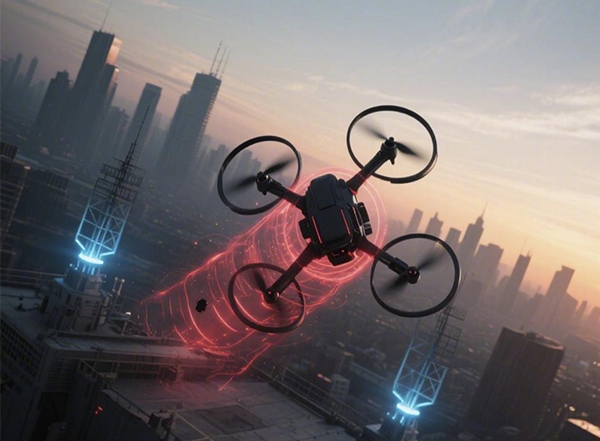
During the most critical phases—airport takeoffs and landings, above major public events, or in the airspace surrounding vital national security assets—the threat posed by unauthorized, uncontrolled “rogue” drones is escalating. How can we effectively counter these intrusions from “low-altitude visitors”? The answer is an intelligent drone defense system that functions as both an “aerial traffic controller” and an “electronic shield”: the Anti-Drone System. This article provides a systematic analysis of how this complex system operates.
I. Definition and Core Components of an Anti-Drone System
An anti-drone system is a comprehensive technological framework designed to secure protected airspace by detecting, identifying, tracking, and ultimately neutralizing unauthorized or threatening drones. Its primary purpose is safeguarding critical infrastructures such as key national facilities, airports, and large-scale venues. Functionally, it can be understood as a coordinated cycle of “Detect, Assess, Neutralize, and Evaluate”, built around four core modules:
Detection Module: Operates by combining radar (“sight”), radio frequency (RF) spectrum monitoring (“listening” to public bands like 2.4GHz/5.8GHz), and electro-optical (EO) devices (“high-resolution observation”) to identify potential targets across a wide area.
Identification Module: Uses AI algorithms to analyze detected targets, determining whether they are drones, their specific models, and their potential intents, while minimizing false alarms from objects like birds or kites.
Tracking Module: Once a target is confirmed as a threat, the EO system (visible-light and thermal imaging cameras) automatically locks onto it, continuously following its flight path with sub-meter accuracy.
Countermeasure Module: Based on the assessed threat level, the system— either automatically or under operator control-selects and applies the most appropriate countermeasure, such as jamming or spoofing.
II. Classification and Operating Principles of Drone Countermeasure Technologies
1. Soft-Kill Anti-Drone Technologies
- Radio Frequency (RF)Jamming: The UAV jamming system directs powerful “electronic noise” toward the target drone, instantly blocking its remote control and video transmission signals. Cut off from its operator, the drone triggers its pre-programmed safety response, typically resulting in an automatic return-to-home or a forced landing.
- GPS Spoofing: The spoofing system broadcasts falsified GPS signals to override the drone’s reception of authentic satellite positioning data, causing navigational disorientation and luring the drone away from the restricted zone.
2. Hard-KillAnti-DroneTechnologies
- High-Energy Laser System: Emits a focused, high-energy laser beam that continuously irradiates the drone. The sustained energy ablates its structure or critical components (e.g., motors, cameras), leading to its failure and crash.
- Interceptor Net: Deploys a large net—launched either from a specialized interceptor drone or from the ground—to physically capture the target drone in mid-air. This method is often used in urban or other settings where falling debris must be avoided.
III. Hardware Components
Drone Detection Equipment: Includes long-range radar, RF spectrum analyzers, and EO camera tracking systems (which integrate high-definition visible-light and thermal imaging cameras) for precise target detection, identification, and tracking.
Drone Countermeasure Equipment: Consists of multi-band jamming antennas, high-energy laser systems, and physical interception devices.
Command and Control Platform: Serves as the central hub where all target data and system status converge. It is presented through a display and control software interface, enabling operator decision-making or automated response initiation.
IV. Software Algorithm Logic
1. Multi-Sensor Fusion: Uses algorithms such as Kalman filters or particle filters to merge data from radar, EO, and spectrum sensors, achieving a target location error of less than 1 meter.
2. AI Decision Engine:
- Target Recognition: Rapidly classifies drone types (e.g., quadcopter vs. fixed-wing).
- Threat Assessment: Automatically evaluates threat levels based on the target’s flight path, speed, altitude, and identification results.
- Countermeasure Strategy Optimization: Employs algorithms like reinforcement learning to dynamically select the optimal combination of countermeasures.
V. Typical Application Scenarios and Technology Combinations
Requirements vary significantly across different operational environments:
Airports and Critical Aviation Sites: Where aviation safety is paramount, a common approach combines GPS spoofing with directional RF jamming. This diverts intruding drones from their course and forces a controlled landing, preventing runway incidents.
Security for Large Events and Important Venues: Demanding rapid response and mobility, a typical setup uses vehicle-mounted, quickly deployable radar alongside handheld drone jamming guns for flexible, on-the-move defense.
Protection of Critical Infrastructure: Sites such as nuclear plants or chemical facilities require extensive coverage and high reliability. Drone defense solutions here often deploy fixed radar arrays integrated with EO camera tracking systems.
VI. Technological Challenges and Future Trends
1. Challenges:
- Complex low-altitude environments (e.g., buildings, trees) can degrade detection accuracy.
- Drone swarms impose extreme demands on multi-target tracking and rapid response capabilities.
2. Trends:
- Increased Intelligence: AI enables millisecond-level decision-making, potentially enhanced by digital twin technology for simulation and engagement modeling.
- Multi-System Integration: Systems are evolving to integrate with broader security and airspace management networks, forming a comprehensive protective ecosystem.
VII. Conclusion
The Anti-Drone System represents a critical extension of modern air defense into low-altitude and ultra-low-altitude airspace. Far more than a simple “jamming gun”, it is a sophisticated system that integrates advances from radar, communications, optics, and artificial intelligence. As drone and anti-drone technologies continue to evolve in their ongoing “spear versus shield” contest, the emergence of smarter, more efficient, and multi-layered “low-altitude security shields” will provide a robust technical foundation for protecting our skies and supporting the safe growth of the low-altitude economy.