
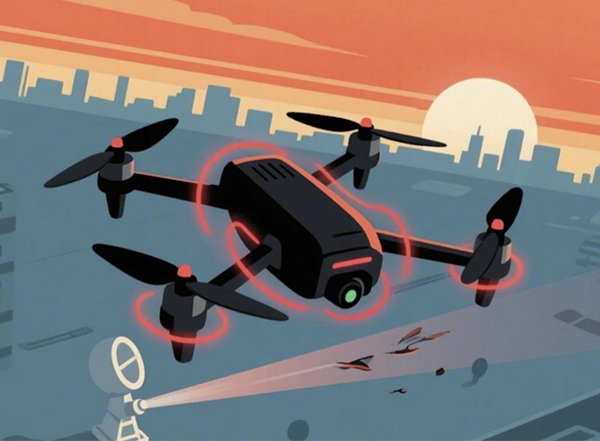
Amidst the development of the low-altitude economy, drone flight activities are increasing daily. However, the widespread application of drones has also introduced a series of security risks, such as “unauthorized flights” and malicious intrusions, posing threats to national security, public safety, and personal privacy.
Deploying anti-drone systems is an essential and wise step to safeguard our skies. Anti-Drone Systems primarily consist of two major components: drone detection and Identification systems and drone countermeasure and neutralization systems. It refers to a systematic drone defense solution for detecting, identifying, tracking, jamming, controlling, or blocking unauthorized and non-compliant drones. Its core objective is to “secure designated airspace and eliminate threats posed by drones”.
I. Detection and Identification – The “Eyes”of the Anti-Drone System
Detection and identification are prerequisites for drone countermeasure operations, aimed at achieving early warning and precise recognition of low-altitude, slow-speed, small-sized (LSS) targets. Due to the inherent limitations of single-technology approaches, integrated drone detection solutions are predominantly employed.
Radio Frequency (RF) Spectrum Detection
Principle: This method monitors wireless signals within the ISM bands (e.g., 2.4 GHz, 5.8 GHz) and GPS/L1 bands. By intercepting communication and navigation signals between the drone and its remote controller, it accomplishes target detection, direction finding, and identification through model fingerprint databases.
Advantages: Long detection range, rapid response time, covert detection without emitting signals, and the capability to identify controller signals.
Radar Detection
Principle: It utilizes specialized radars optimized for detecting LSS targets. These radars transmit electromagnetic waves and analyze the reflected echoes to achieve target positioning, velocity measurement, and trajectory tracking.
Advantages: Capable of all-weather operation, featuring a long detection range, and effective performance in adverse weather conditions.
Electro-Optical/Infrared (EO/IR) Identification
Principle: The camera drone tracking system integrates high-definition visible-light cameras with infrared thermal imagers. Guided by initial cues from radar or RF detector, it provides optical confirmation and continuous video tracking of the target.
Advantages: Delivers the most intuitive visual information, enabling precise target identification and supporting subsequent forensic analysis.
II. Countermeasureand Neutralization – The “Hands”of the Anti-Drone System
Following target confirmation, the anti-drone system selects the most appropriate neutralization method based on pre-defined operational protocols and the specific environmental context.
Radio Frequency Drone Jamming
Principle: This technique employs directional or omnidirectional high-power noise signals to jam the drone’s command and control link and its satellite navigation link. It is categorized as a non-kinetic “soft-kill” method.
Effect: The loss of the control link triggers the drone’s failsafe protocols, typically forcing it to execute an emergency landing or initiate an automatic return-to-home (RTH) sequence.
GPS Spoofing
Principle: This method generates and transmits simulated GPS signals with a slightly higher power level than the authentic signals, thereby feeding the target drone with false spatiotemporal coordinates. It is also a non-kinetic “soft-kill” technique that allows for “directional guidance” with minimal impact on the surrounding electromagnetic environment.
Effect: It takes control of the drone’s navigation system, capable of luring it away from a protected area for expulsion or forcing it into a controlled landing.
Net Capture InterceptionPrinciple: This method involves deploying interceptor platforms to launch capture nets, or using larger carrier drones to carry and deploy nets for mid-air physical capture. As a “hard-kill” method, it enables the intact recovery of the target drone, facilitating subsequent forensic investigation.
Kinetic and Directed Energy Attack
Principle: Laser systems use high-energy laser beams for sustained irradiation to thermally destroy critical components of the drone. High-Power Microwave (HPM) systems emit wide-area microwave pulses to disable the drone’s internal electronic circuitry.
III. Command and Control – The “Brain” of the Anti-Drone System
This component integrates all sensors and effector units to achieve situational awareness fusion, decision support, and coordinated system control.
Anti-drone system technology plays a vital role in ensuring the security of the low-altitude economy. As drone technology continues to evolve, future low-altitude security will inevitably rely on a comprehensive, integrated system architecture based on multi-dimensional sensing, intelligent decision-making, and coordinated neutralization. This will provide a more robust foundation for the secure and sustainable development of the low-altitude economy.